
"Well, it wouldn't surprise me!"
How online discourse deflects from responsibility

For several years now, a friend and I have used this post’s title as shorthand for a phenomenon that plagues social media. It’s no secret that basically every social network is rife with misinformation that spreads like wildfire and takes root before corrections can be issued. A significant chunk of this is spread via malicious actors — hyper-partisan “news” pages, deceptively edited video, selective headlines and the like — before filtering down to the commons. While the online right is particularly prone to falling for this junk, it’s certainly not a problem exclusive to them (in fact Hurricane Helene, the event that inspired this post, has seen an unfortunate amount of left-wing misinfo based on a per se distrust of government). In any case, this post isn’t about ideological susceptibility to misinformation, but rather a lament of the attitudes people take in response to being called out.
Psychology literature generally agrees: people don't like being told they're wrong. In fact, they dislike it so much that being presented with a correction that directly contradicts their views is actually *more* likely to get them to double down on those views. This does often manifest itself in wholesale rejection of the contradictory facts, but it’s deeper than that. Past a certain point of wallowing in the misinfo sewage, you lose both your ability to sniff it out and the ability to take the L.
The other day, Georgia Republican activist and national committeewoman Amy Kremer tweeted the following:
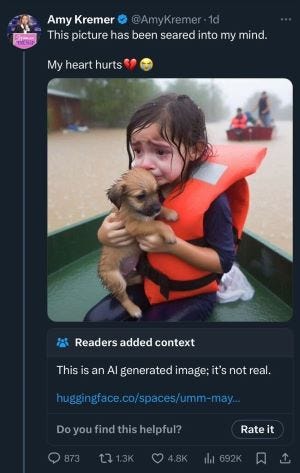
I could do a whole post on why you shouldn’t need the note here to figure out this is AI-generated slop. During natural disasters it’s necessary to be on even higher alert than usual for fake images — you often see stuff floating around from several years purporting to be a live look at the current disaster. But come on, just look at it!
But hey, people are feeling sad about the damage Helene has wrought; falling for something that pulled on the heartstrings isn’t the worst thing in the world, all things considered. It’s a little embarrassing, but easy enough to delete and screenshot for posterity in your correction!
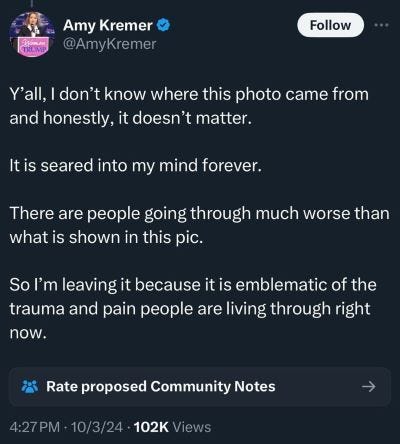
Well, that’s quite a bit more embarrassing.
Only one of the statements in this follow-up appears to be true: some people have lost all their possessions and livelihood, or worse, their lives, so certainly there are people going through “worse”. As for the rest…
Ms. Kremer does indeed know where this photo came from: someone typing “sad child holding puppy during flood” into one of the many available generative AI photo generators, expending enough energy in that photo to fully charge the phone used to type it in. She knows because pretty much everyone in the comments explained it to her, and because otherwise she wouldn’t be responding at all.
It is not emblematic of anything. There is no trauma being depicted in this “photo”, and in fact it’s unlikely the model that created it was trained on any images from Hurricane Helene. It’s nonspecific to anything that has happened in the last week or so, and no more symbolic than the live-action Lion King films are of real struggles between male lions in the savannah.
It matters where it came from in the same way that it matters whether you get upset at someone for something they did in a dream. Certainly intense dreams can sear into our minds, but typically we shouldn’t allow them to linger there forever.
The key sentiment here though is not sadness, but defiance born of self-righteousness. Look, it may be fake, but I posted this because it recalls the very REAL suffering, which everyone can agree we should feel bad about. In fact, if you point out to me that I’m doing it wrong, you’re part of the problem! What I posted may indeed be flatly incorrect, but if it were somehow true, It Wouldn’t Surprise Me!
This is how people who may mean well (or believe that they mean well) are able to justify being vectors of misinformation. They are not a part of the system, so they cannot be blamed for its effects — they were, after all, just trying to spread the word about something important. If they were wrong, well, at least the message is out there. It’s important, so much so that the message supersedes any supporting information.
The lies about the federal hurricane response have spread so fast that a Frequently Asked Questions page has had to be put out. FEMA is only giving a $750 loan to hurricane victims! They’re actively impeding relief efforts and setting up no fly zones! Also they ran out of money because they gave it all to immigrants/foreign aid! Well ok, they may be giving a lot more than $750, the relief effort may have won bipartisan praise from actual state officials, and the funding streams for relief and foreign aid may be totally separate. But what you haven’t considered is that the U.S. government has screwed up before with Hurricane Katrina, and that we do actually spend too much money on something I hate. Frankly, that’s enough to assign malicious intent to any issues that may have cropped up as a result of destroyed infrastructure and downed communications networks. Moreover, the fact that I fell for something easily disprovable is just proof that this issue just isn't being covered enough by the mainstream media!
Past a certain point this defensive posture ceases to be about ideology and becomes about how Things Are So Crazy These Days. It’s all nuts out there, so if I hear something that sounds kind of right but isn’t, it doesn’t say anything about my assumptions. In fact, it’s those very assumptions that tell me that a real story just like this is right around the corner. And honestly? It’ll probably turn out later that I was more or less right about this one too. I will move on to the next thing, never to revisit this episode, but if I did and that happened, it wouldn’t surprise me!